


JavaScript Promises
Avsnitt: JavaScript
A Promise is a proxy for a value not necessarily known when the promise is created. It allows you to associate handlers with an asynchronous action's eventual success value or failure reason. This lets asynchronous methods return values like synchronous methods: instead of immediately returning the final value, the asynchronous method returns a promise to supply the value at some point in the future.
A Promise is in one of these states:
pending: initial state, neither fulfilled nor rejected.
fulfilled: meaning that the operation was completed successfully.
rejected: meaning that the operation failed.
The eventual state of a pending promise can either be fulfilled with a value or rejected with a reason (error). When either of these options occur, the associated handlers queued up by a promise's then method are called. If the promise has already been fulfilled or rejected when a corresponding handler is attached, the handler will be called, so there is no race condition between an asynchronous operation completing and its handlers being attached.
A promise is said to be settled if it is either fulfilled or rejected, but not pending.
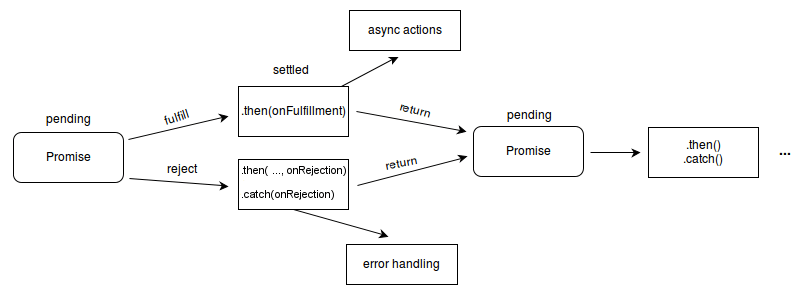
You will also hear the term resolved used with promises — this means that the promise is settled or "locked-in" to match the eventual state of another promise, and further resolving or rejecting it has no effect. The States and fates document from the original Promise proposal contains more details about promise terminology. Colloquially, "resolved" promises are often equivalent to "fulfilled" promises, but as illustrated in "States and fates", resolved promises can be pending or rejected as well. For example:


Avsnitt: JavaScript
JavaScript Promises
A Promise is a proxy for a value not necessarily known when the promise is created. It allows you to associate handlers with an asynchronous action's eventual success value or failure reason. This lets asynchronous methods return values like synchronous methods: instead of immediately returning the final value, the asynchronous method returns a promise to supply the value at some point in the future.
A Promise is in one of these states:
pending: initial state, neither fulfilled nor rejected.
fulfilled: meaning that the operation was completed successfully.
rejected: meaning that the operation failed.
The eventual state of a pending promise can either be fulfilled with a value or rejected with a reason (error). When either of these options occur, the associated handlers queued up by a promise's then method are called. If the promise has already been fulfilled or rejected when a corresponding handler is attached, the handler will be called, so there is no race condition between an asynchronous operation completing and its handlers being attached.
A promise is said to be settled if it is either fulfilled or rejected, but not pending.
You will also hear the term resolved used with promises — this means that the promise is settled or "locked-in" to match the eventual state of another promise, and further resolving or rejecting it has no effect. The States and fates document from the original Promise proposal contains more details about promise terminology. Colloquially, "resolved" promises are often equivalent to "fulfilled" promises, but as illustrated in "States and fates", resolved promises can be pending or rejected as well. For example:
Gruppkommentarer




 +10
+10
Avsnitt: JavaScript
JavaScript Promises
A Promise is a proxy for a value not necessarily known when the promise is created. It allows you to associate handlers with an asynchronous action's eventual success value or failure reason. This lets asynchronous methods return values like synchronous methods: instead of immediately returning the final value, the asynchronous method returns a promise to supply the value at some point in the future.
A Promise is in one of these states:
pending: initial state, neither fulfilled nor rejected.
fulfilled: meaning that the operation was completed successfully.
rejected: meaning that the operation failed.
The eventual state of a pending promise can either be fulfilled with a value or rejected with a reason (error). When either of these options occur, the associated handlers queued up by a promise's then method are called. If the promise has already been fulfilled or rejected when a corresponding handler is attached, the handler will be called, so there is no race condition between an asynchronous operation completing and its handlers being attached.
A promise is said to be settled if it is either fulfilled or rejected, but not pending.
You will also hear the term resolved used with promises — this means that the promise is settled or "locked-in" to match the eventual state of another promise, and further resolving or rejecting it has no effect. The States and fates document from the original Promise proposal contains more details about promise terminology. Colloquially, "resolved" promises are often equivalent to "fulfilled" promises, but as illustrated in "States and fates", resolved promises can be pending or rejected as well. For example:
Gruppkommentarer
+10
Avsnitt: JavaScript
JavaScript Promises
A Promise is a proxy for a value not necessarily known when the promise is created. It allows you to associate handlers with an asynchronous action's eventual success value or failure reason. This lets asynchronous methods return values like synchronous methods: instead of immediately returning the final value, the asynchronous method returns a promise to supply the value at some point in the future.
A Promise is in one of these states:
pending: initial state, neither fulfilled nor rejected.
fulfilled: meaning that the operation was completed successfully.
rejected: meaning that the operation failed.
The eventual state of a pending promise can either be fulfilled with a value or rejected with a reason (error). When either of these options occur, the associated handlers queued up by a promise's then method are called. If the promise has already been fulfilled or rejected when a corresponding handler is attached, the handler will be called, so there is no race condition between an asynchronous operation completing and its handlers being attached.
A promise is said to be settled if it is either fulfilled or rejected, but not pending.
You will also hear the term resolved used with promises — this means that the promise is settled or "locked-in" to match the eventual state of another promise, and further resolving or rejecting it has no effect. The States and fates document from the original Promise proposal contains more details about promise terminology. Colloquially, "resolved" promises are often equivalent to "fulfilled" promises, but as illustrated in "States and fates", resolved promises can be pending or rejected as well. For example:
Gruppkommentarer
+10
Avsnitt: JavaScript
JavaScript Promises
Uppgift
Quiz
Betyg
IG-VG
Duration
10 minuter
Poäng
10
A Promise is a proxy for a value not necessarily known when the promise is created. It allows you to associate handlers with an asynchronous action's eventual success value or failure reason. This lets asynchronous methods return values like synchronous methods: instead of immediately returning the final value, the asynchronous method returns a promise to supply the value at some point in the future.
A Promise is in one of these states:
pending: initial state, neither fulfilled nor rejected.
fulfilled: meaning that the operation was completed successfully.
rejected: meaning that the operation failed.
The eventual state of a pending promise can either be fulfilled with a value or rejected with a reason (error). When either of these options occur, the associated handlers queued up by a promise's then method are called. If the promise has already been fulfilled or rejected when a corresponding handler is attached, the handler will be called, so there is no race condition between an asynchronous operation completing and its handlers being attached.
A promise is said to be settled if it is either fulfilled or rejected, but not pending.
You will also hear the term resolved used with promises — this means that the promise is settled or "locked-in" to match the eventual state of another promise, and further resolving or rejecting it has no effect. The States and fates document from the original Promise proposal contains more details about promise terminology. Colloquially, "resolved" promises are often equivalent to "fulfilled" promises, but as illustrated in "States and fates", resolved promises can be pending or rejected as well. For example:
Gruppkommentarer
+10
JavaScript Promises
Avsnitt: JavaScript
A Promise is a proxy for a value not necessarily known when the promise is created. It allows you to associate handlers with an asynchronous action's eventual success value or failure reason. This lets asynchronous methods return values like synchronous methods: instead of immediately returning the final value, the asynchronous method returns a promise to supply the value at some point in the future.
A Promise is in one of these states:
pending: initial state, neither fulfilled nor rejected.
fulfilled: meaning that the operation was completed successfully.
rejected: meaning that the operation failed.
The eventual state of a pending promise can either be fulfilled with a value or rejected with a reason (error). When either of these options occur, the associated handlers queued up by a promise's then method are called. If the promise has already been fulfilled or rejected when a corresponding handler is attached, the handler will be called, so there is no race condition between an asynchronous operation completing and its handlers being attached.
A promise is said to be settled if it is either fulfilled or rejected, but not pending.
You will also hear the term resolved used with promises — this means that the promise is settled or "locked-in" to match the eventual state of another promise, and further resolving or rejecting it has no effect. The States and fates document from the original Promise proposal contains more details about promise terminology. Colloquially, "resolved" promises are often equivalent to "fulfilled" promises, but as illustrated in "States and fates", resolved promises can be pending or rejected as well. For example:
Uppgift
Quiz
Betyg
IG-VG
Duration
10 minuter
Poäng
10
Gruppkommentarer
+10
Gruppkommentarer